Moving Beyond the Chatbot
Role: Senior Product Designer
Company: Fico
Duration: 8 months
Team: PMs, Dev team, Architecture team, Researcher
The problem
In complex decisioning and orchestration workflows, architects and builders need to experiment safely, maintain clear version history, and work across branches without breaking live or shared compositions. Yet traditional version lists flatten history into a linear sequence, making it hard to see which branch a version belongs to, how branches diverge or relate, or what the flow actually looks like at a given point in time. At the same time, switching between version history, branch management, and the canvas itself creates unnecessary context friction when trying to inspect changes, compare states, or recover safely.
How I solved it
Visual Branch-and-Commit Graph: Replaced flat version lists with a visual branching graph that shows version lineage, branch splits, and active selections at a glance.
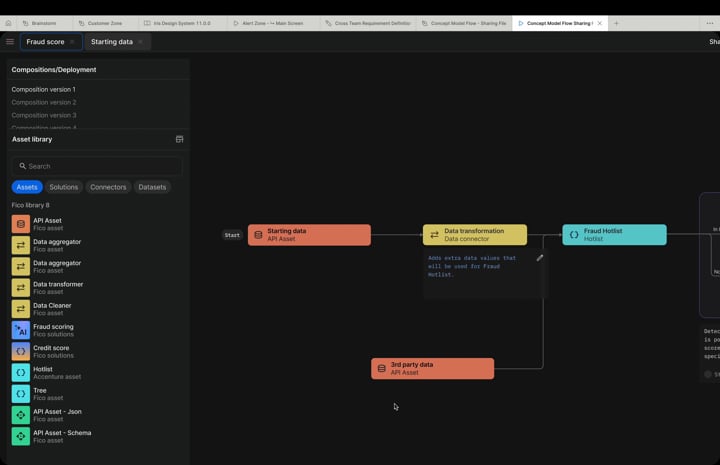
Synchronized Canvas & Inspector Context: Paired version and branch views directly with a live canvas preview so builders can see how a flow is structured in a specific version or branch rather than guessing from text labels alone.
Spatial & Theme Explorations for Dense Workflows: Explored bottom-drawer and split-panel layouts—alongside light and dark modes—to balance canvas visibility with room for version history and branch details during longer, higher-density sessions.


Making Invisible Data Dependencies & Breaks Visible on the Canvas


Git-Style Branching & Version History Inside the Workspace
Clearer Branch & Version Orientation
Made branch relationships and historical states immediately legible instead of burying them in disconnected or linear lists.
Safer Iteration & Review
Allowed builders to inspect earlier versions and branches alongside the canvas before committing to changes or promoting work.